After years trying to hone the art of storytelling, something dawned on me the other day: great content never quite conforms. It is always just a bit different; typically in delivery and/or in message. And it always has an element of surprise, even if only a trace.
I started to wonder and obsess over what this meant as we set out on our content journey – both in delivering for clients but also our own content marketing approach.
The thing is, many stories, blogs, articles, videos, podcasts and so on are perfectly fine. They are perfectly readable and deliver information accurately. And yet they fail to really connect. Also, who really ever sets out to be ‘perfectly fine’?
By definition, average pieces lack something; a certain je ne sais quoi.
Wiggle it, just a little bit
Granted, it has taken me a while to figure all this out (consciously, at least), but this missing essence is what great content is all about. It is what connects you to your audience and makes you memorable. The missing magic is like a wiggle. It’s just enough of a detour to jolt your audience out of autopilot, but not too much so as to turn them off.
This last bit is crucial. Research tells us that our emotions and feelings determine what sticks. So set an expectation, bend it slightly and sit back and watch attention spike. Curiosity desperately tries to close the gap between what we know and what we want to know; or rather, what we expect and what we find.
That’s economist George Loewenstein’s information-gap at work.[1] Neuroscientist Beau Lotto’s work complements this: “We do not experience the world as it is because our brain didn’t evolve to do so.”[2]
From music to comedy to art and architecture, the same mechanism is at work. When a stable groove is nudged by a well-timed surprise, the pleasure peak arrives when prediction meets just-right violation.[3],[4]
Processing-fluency studies show we like what is easy to parse – prototypes, symmetry, recognisable forms – while the von Restorff effect reminds us that distinctive elements draw attention and linger in memory.[5] Aesthetics researchers describe an inverted-U for novelty and complexity: move from dull to fresh and enjoyment climbs; push into baffling and it falls away.[6] Humour theory nods in the same direction. Jokes land when a norm is broken, but done safely – a ‘benign violation’, if you will.[7]
This attention to patterns of intermediate predictability is pretty ingrained, too. Infants show the same Goldilocks instinct, so the preference starts early and never quite leaves us.[8] So the wiggle is often the only part people remember.
The non-linearity of cricket bats
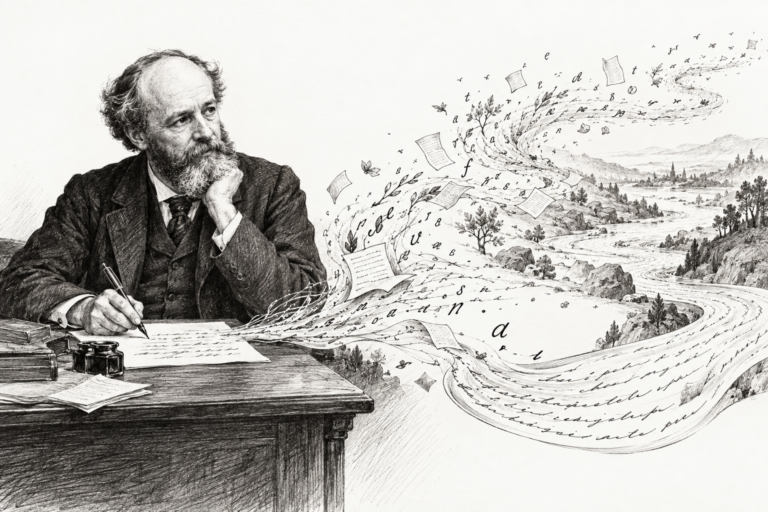
“This [cricket bat] here, which looks like a wooden club, is actually several pieces of particular wood cunningly put together in a certain way so that the whole thing is sprung, like a dance floor…” The spring is what sends the ball further than the swing alone could manage. This is no different to what readers feel when a piece wiggles a wee bit and in doing so releases more meaning than a straight thwack ever would.
“What we’re trying to do is write cricket bats, so that when we throw up an idea and give it a little knock it might travel…”[9] Thank you, Sir Tom Stoppard. RIP. You not only remind us that cricket, tea and scones represent the highest form of civilization, but that words, strung together properly, exhibit a powerful multiplier effect.
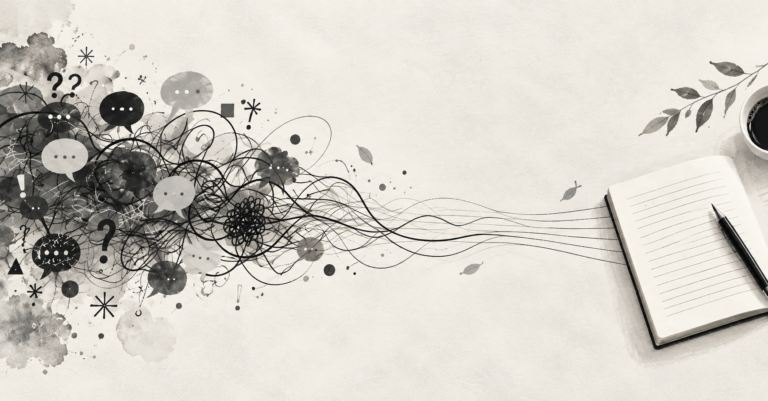
In true Stoppardian fashion, there’s a deeper reason why great content needs to wiggle: all writing is inherently linear, but the world is most definitely not. Sentences march in single file. One paragraph follows another. The act of arranging events on the page suggests a clean sequence – a clear cause, a clear effect, a clear lesson.
Yet the systems we write about rarely cooperate. Markets, organisations, customer journeys and cultures move in loops, feedbacks, cascades and sudden breaks. Tiny accidents compound into large outcomes.
And when that chaos is poured into a neat column of prose, there is a strong temptation to shave off the untidy edges so the story appears to “add up”. Yet just because the story is smooth, we start to believe the underlying reality must have been smooth as well. We tell ourselves there was a main driver, a clear turning point or a decisive insight. Mostly, there was not. Many things were true at once, and one thread has been chosen to stand in for the whole tangle.
Stoppard knew this and would write in sophistication layers, taking care to never patronise his audience. People may not know the full tangle, but they can feel when a story has been over-simplified. They know when the truth has been glossed over and a single cause and effect is misguidedly inferred. Astute readers sniff this out a mile off.
Political scientist Brian Klass puts it perfectly, “When our economic and political models of reality reduce a breathtaking world full of the richness of fractals and Fibonacci spirals into sterile, fixed linear equations that can be solved with a mere handful of easily measured variables, our vision of ourselves and our surroundings becomes duller.”
A well-judged wiggle is therefore a small but important signal that the writer knows the world is messier than the paragraph suggests, and is willing to acknowledge that without abandoning clarity (or hope).
Wiggle without wobble
If reality and reason won’t succumb neatly to the universal laws of physics, why should writing and marketing output?
Or put another way, how do you wiggle without wobbling?
One useful approach is to anchor around the orthodox view so the reader knows where they are. Then have some fun. Tilt and bend it: introduce the tension or question that makes the obvious answer feel less comfortable. Now you can really explore the detour. Borrow examples from unlikely domains like film, architecture, stand-up, science and so on. This is where the voice and idea can stretch a little. Finally, land close to where you began, but with some punch and depth. Handled well, that sequence shows that the writer genuinely thinks in layers.
Marketers often fear that such deviations from straight logic will cost them readers. For sure, some will be lost. But they are usually the ones who were never going to buy or act anyway.
Think of it this way: linear content formulaically optimises for completion; meanwhile, the wiggle aims to connect. Publish too many straight lines and your audience will skim. They learn that your pieces are predictable, so they mine them for the one number or recommendation they need and ignore the rest. Publish straight pieces with disciplined wiggles, and they might just learn who you are. Yet, publish pieces with genuine wiggles and surprises and they might even pay attention.
Ultimately, people follow thought leaders because they never quite know exactly where they will take an idea. They follow them to have their views challenged and because they offer new ways of seeing the world. In a market saturated with content, uncertainty of the right kind becomes an asset. And once people come for the thinking, you can point them almost anywhere.
In a world that increasingly rewards safe, standard and sameness, the wiggle is a small act of deviance. It says: I know the script, but I’m going to break it here, just enough to challenge your thinking and help you remember. That’s how you build an audience that comes not just for the updates, but for the thinking – for the one person in the room who’s still willing to be a little offbeat.
In marketing, this is hardly profound insight. Content strategists Shane Snow and Joe Lazauskas call it the balance of relatability and novelty. A story has to feel fluent and human, then carry one tension that bends expectation. And marketing research group System1’s testing comes to much the same place: the ads that endure are the ones people feel (familiar frames with a single, crafted surprise) because a little difference against a known pattern travels further and lasts longer.
After all that, my learning essentially boils down to something quite simple: all great stories wander. They double back. They hesitate. They change direction. Crucially, they wiggle.
Sources:
[1] Loewenstein, “The Psychology of Curiosity,” 1994
[2] Lotto, Deviate, 2017
[3] Huron, Sweet Anticipation, 2006;
[4] Cheung et al., Nature Human Behaviour, 2019.
[5] Reber, Schwarz & Winkielman, Personality and Social Psychology Review, 2004; von Restorff, 1933.
[6] Berlyne, Aesthetics and Psychobiology, 1971; Marin, Frontiers in Human Neuroscience, 2016.
[7] McGraw & Warren, Social and Personality Psychology Compass, 2010.
[8] Kidd, Piantadosi & Aslin, PLoS One, 2012.
[9] Stoppard, The Real Thing, 1982