Why do so many asset managers sound alike? It’s a problem that plagues the industry, making a mockery of our collective marketing effort.
So, are we all failing? Are we really that bad at our jobs?
I’ve been involved in my fair share of messaging houses and corporate rebrands over the years. Despite good intentions, there’s an undeniably strong magnetic force that sucks firms towards the ‘vortex of mid’, as content marketing guru Joe (Lazer) Lazauskas calls it. As we collectively revert to the mean, the end output becomes average and bland.
I used to blame this on corporate conservatism, general risk aversion and compliance. While all true, to a point, a recent podcast listen knocked a few rusty knowledge cogs into place and gave me a better sense of what might be happening.
I’m an occasional listener of Acquired, enjoying their deep analysis of companies like TSMC and Microsoft. Health warning: episodes are a minimum of four hours long.
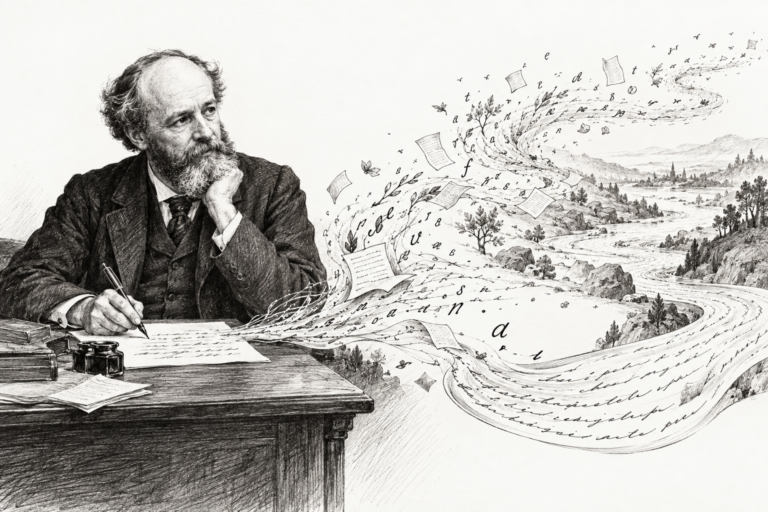
Anyway, for their 10-year anniversary, they convinced storytelling genius Michael Lewis to play chat-show host and probe into their own research and production process. While exchanging creative process notes[1], Ben Gilbert started talking about lossy compression, linking it to language and thought. His argument is that language can never fully capture the essence of thought.
Boom. That was it. My mind was off to the races. The limitation of language is something I think about way too much. Once I got over the annoying fact that I hadn’t thought of it like this before, I started to explore what it might really mean.
The compression chamber
First up, lossy compression is a concept I was only vaguely aware of. Anthony Brandt and David Eagleman refer to it in their book on creativity, The Runaway Species, when describing how the technical engineers figure out how to get YouTube to work. I think it was also touched on briefly in the Netflix series on Spotify in relation to solving some of their bandwidth and streaming challenges.[2]
In computing, lossy compression is essentially shrinking something big and detailed into something small and portable. In doing so, you accept that elements will be thrown away. JPEGs are ‘good enough’ pictures. MP3s are ‘good enough’ music. The file becomes shareable, but some nuances are gone forever.
This is fine when the sacrificed parts are imperceptible to the human eye or ear. But what if a form of lossy compression happens in other areas of life?
Surely any complex system must undergo some form of lossy compression for us to get close to understanding it. Firms are a perfect example. Highly complex; they are living, breathing, historically scarred and socially dynamic organisms. They are high-resolution entities that contain tacit knowledge, habits, judgement calls, trade-offs, in-jokes, rivalries, rituals, war stories and a thousand little micro-decisions that never make it into a pitch deck.
A value proposition, by contrast, is a tiny file format. A few lines on a website. A slide. A paragraph in an RFP. A sentence the sales team can repeat without reading off a script.
And because the output must travel (across geographies, channels, audiences, product lines and internal stakeholders), it gets compressed until it fits.
That’s not ideal.
The finite thesaurus
Most corporate cultures are not written; they evolve organically. A value proposition should be a function of your culture – the things that make your firm unique. In heavily commoditised industries, their importance is amplified. Beyond investment performance, if you can’t communicate what makes you special and different, asset raising and retention can become challenging. It’s a form of non-performance alpha.
My issue with language stems from the fact that human experience is wildly high-dimensional, yet language is relatively flat and thin.
Think about pain and the language we have for it. When was the last time you were at the doctor trying to convey the specifics of your discomfort? Aware that my vocabulary is limited and nowhere near the full spectrum of linguistic possibilities, I still get frustrated at my lack of ability to communicate something so important – a dull ache, or a sharp stabbing pain is about the extent of my expressive talent. Then we retreat to nonsensical relative scale assessments for severity, with no way of understanding or cancelling out any variances in pain thresholds.
I digress. When I hear corporate claims like “global, innovative, client-centric and long-term,” I now realise they aren’t lying, they’re being compressed; they’ve succumbed to the finite nature of language and the gravitational forces pulling them away from creative expression. These clichés are the MP3s of identity. They survive the internal edit cycle, the compliance lens and the various cultural translation litmus tests.
Put another way, the thing you’re trying to market – the real source of edge – often lives in the messy middle that you’re least able to write down.
So, the story gets simplified. The nuance is shaved off. The sharp edges are sanded for safety. The narrative becomes nearly reasonable, but not quite. And that is precisely where sameness lives.
Anti-compression tablets
You can’t eliminate lossy compression. The format – indeed writing itself – requires it. But you can change what gets preserved; the stuff you refuse to throw away. The trick is to stop pretending you can smuggle a living culture through a five-line value prop without casualties and instead get intentional about which parts you are willing to lose.
Start by being suspicious of adjectives. ‘Robust’, ‘differentiated’, ‘disciplined’, these all sound impressive, but don’t create any shape or meaning. A firm with a real edge usually has some kind of repeatable behaviours or constraint that forces the edge into existence – a decision rule, an operating rhythm, a portfolio construction habit or a governance quirk.
So instead of telling us you’re ‘high conviction’, tell us what that costs you in practice: that you cap the portfolio at X names, that you kill ideas after Y months without new evidence, that you won’t own something unless you can explain it without PowerPoint. That you are so long term in your thinking you almost never open Bloomberg. These signals don’t always have neat numerical values, but they can and do describe observable behaviour.
Related to that: name the trade-off you embrace. True edge nearly always has a downside. If your proposition has no cost, it’s probably not true, or it’s true for everyone. Most firms want the benefits of distinctiveness without the discomfort of exclusion. But savvy clients can smell that. Sacrificing X to get Y is uncomfortable, which is precisely why it tends to be distinctive.
Then preserve one or two ‘tells’ of the culture. A value proposition doesn’t need to list your entire operating system, but it should be authentic and ownable. A phrase only you would say. Behaviours you repeat so often they become reflexes. The point isn’t to be quirky for the sake of it; it’s to keep a small piece of high-resolution truth in the file.
Finally, build a ‘compression budget’. Decide in advance what you will not allow to be lost, no matter how many rounds of edits occur. A non-negotiable sentence or a concrete behavioural claim. A handful of proof points. If you don’t pick your non-negotiables up front, the process will end up picking them for you; usually, this means the safest and most forgettable version.
Lossy, not glossy
There’s a deep irony here, of course: I’ve had to compress a thought about thought compression. But the main point, I hope, is clear: we don’t want to be another thought leadership shop floating at 30,000 feet. We want to be the people who can take the messy, non-linear reality inside an investment firm – the judgement, the trade-offs and the culture – and translate it into writing that doesn’t pretend the world is tidy just because sentences have to be.
The truth is that our own value proposition is still a work in progress, and subject to the very same lossy compression forces.