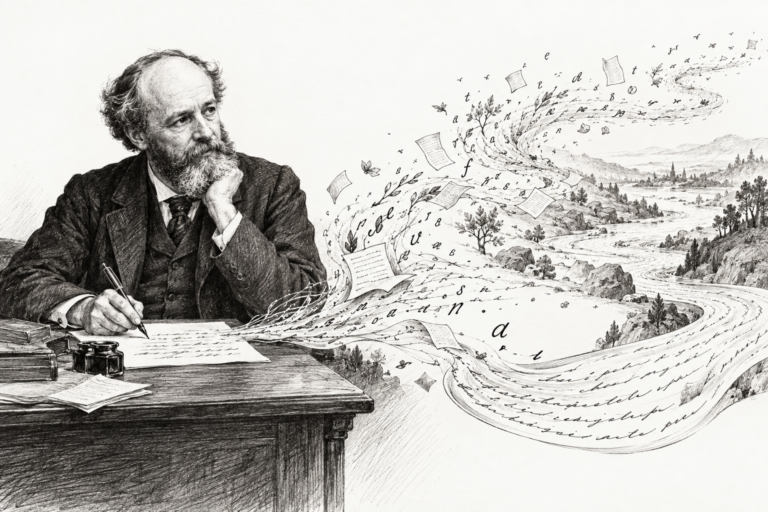
Every great investment idea begins with a story: a way of seeing the world that others have missed.
The same is true of great marketing. The campaigns that really stick in the mind weren’t just clever; they were rooted in authenticity – some sort of technical edge, category insight or behavioural pattern – and then expressed with an elegance and simplicity that makes any content creator want to retreat to a very dark room and cry.
This helps explain and contextualise a recurring thought of mine:
Often, the best placed people to find those truths – content specialists – are brought in at the final step in the creative process. We get pulled in to sanity check a near-finished concept – to tighten the copy and smooth the edges. This isn’t right.
As I write, alarms going off in my head (I would think this, wouldn’t I?). But the idea keeps resurfacing so, for my own sanity, it’s worth exploring. After all, as E. M. Forster put it: “How do I know what I think until I see what I say?”[1]
Creative Venn diagram
Content folk come in all shapes and sizes. But the best ones in investment management sit at the centre of a creative Venn diagram. They:
- Obsess over markets and the investment process – enough to spot what matters and sniff out the BS
- Understand the firm’s commercial priorities and constraints (flows, channels, audiences, risk appetite and distribution realities)
- Have the storytelling nous to turn complexity into something that resonates.
These people are rare, but undervalued.
In such a commoditised industry this is, quite frankly, weird. There are tens (or hundreds) of firms trying to stand out in every major sub-asset class or investing style. Yet their offerings are all eerily similar. So why not invest in the very people who can help you stand out from the crowd?
I genuinely can’t figure out why it doesn’t happen more. Most firms have moved to hero content; the next step is moving content upstream so the ‘hero’ is built on something only you can say. Ultimately, involving content from the beginning means the work starts closer to the engine room. It becomes less like copywriting and more like product or brand investigative journalism – interrogating the business until a campaignable truth falls out.
Content creative in the wild
A cursory look at a handful of iconic campaigns reveals a pattern: the creative is often a simple wrapper around a hard-won truth that required deep product or category understanding.
Intel Inside didn’t sell a mood. Instead, it sold an invisible technical component as a visible signal of quality which was backed by a cooperative marketing model that reimbursed OEM advertising featuring the Intel brand.[2]
Equally, Volvo Trucks’ “Epic Split” didn’t talk about innovation per se. It dramatised a specific engineering benefit (precision and stability via Volvo Dynamic Steering) in one unforgettable demonstration.[3] And Salesforce’s “No Software” worked because it distilled a technical and business-model shift (cloud-delivered software) into a blunt, provocative stance that a market could immediately understand.[4]
It’s practically impossible to create such marketing brilliance from a distance. These campaigns had to be created by teams who understood the underlying essence of the corporate culture and proposition deeply enough to simplify it without distorting it. With smaller marketing budgets in investment management, there’s no operating license to burn cash on a creative advertising team immersing themselves in your firm for the best part of three months.
To be clear, we are not arguing for content specialists to replace creative agencies or step outside their craft. We are simply arguing for a rethink of where the best creative ideas often originate. The people most likely to surface that material are the ones who can spar with PMs and CIOs, ask the annoying questions and keep digging until the answer becomes both defensible and memorable.
The evidence (and the trap)
There’s also a practical reason this matters in finance, in particular. Credibility is an absolute must to gain trust given the complexity. Buyer research consistently finds that senior decision-makers want providers who understand their context – not just their product. As a useful aside, substantive thought leadership can carry more weight than marketing collateral in assessing capability.[5],[6]
There is, of course, a catch (every strawman argument has one). Deep expertise can also create a communications failure. It’s the “curse of knowledge”: better-informed people systematically overestimate what others know, and default to insider language.[7] The goal should be to start with the technical truth, then translate it. That translation is exactly what the best content specialists do when they’re given a seat at the table early enough.
Interestingly, the same logic applies to value propositions and corporate manifestos. The strongest ones don’t start with adjectives. Instead, they start with the people closest to the substance and then get shaped into language that lands your message.
When content is treated as creative capital, it becomes a source of advantage that compounds: sharper propositions and ideas that travel because they are true before they are polished. In an industry full of firms desperately trying to differentiate, this doesn’t feel radical; it feels long overdue.
Sources:
[1] Quote attribution note: the aphorism is widely attributed to E. M. Forster, who included it in Aspects of the Novel (1927); see Quote Investigator (11 December 2019). https://quoteinvestigator.com/2019/12/11/know-say/
[2] Intel. “Inside Intel Inside” (Intel Timeline; 1991).
[3] Volvo Trucks. “The Epic Split feat. Van Damme (Live Test)” (YouTube video; 13 November 2013).
[4] TechCrunch. “Salesforce at 20 offers lessons for startup success” (8 March 2019).
[5] Forrester. “Will Your B2B Content Meet Buyer Expectations In 2022?” (19 November 2021).
[6] Camerer, C., Loewenstein, G., & Weber, M. “The Curse of Knowledge in Economic Settings: An Experimental Analysis.” Journal of Political Economy 97(5), 1232–1254 (1989).
[7] Hovland, C. I., & Weiss, W. “The Influence of Source Credibility on Communication Effectiveness.” Public Opinion Quarterly 15(4), 635–650 (1951).